
Some pretty sobering news slipped through the cracks almost unnoticed last year. Several forests across the globe are emitting more carbon than they are absorbing, with reports suggesting they are on track to do so even more in the coming years, as the New Scientist reports. Forests in Finland, Germany and the Czech Republic have been impacted, and similar concerning patterns are emerging in boreal forests across Alaska and Canada.
The decline in forests’ capacity to effectively capture carbon is one of the many reasons why Earth will breach 1.5 °C warming a decade early, a stark warning that came just days into 2026.

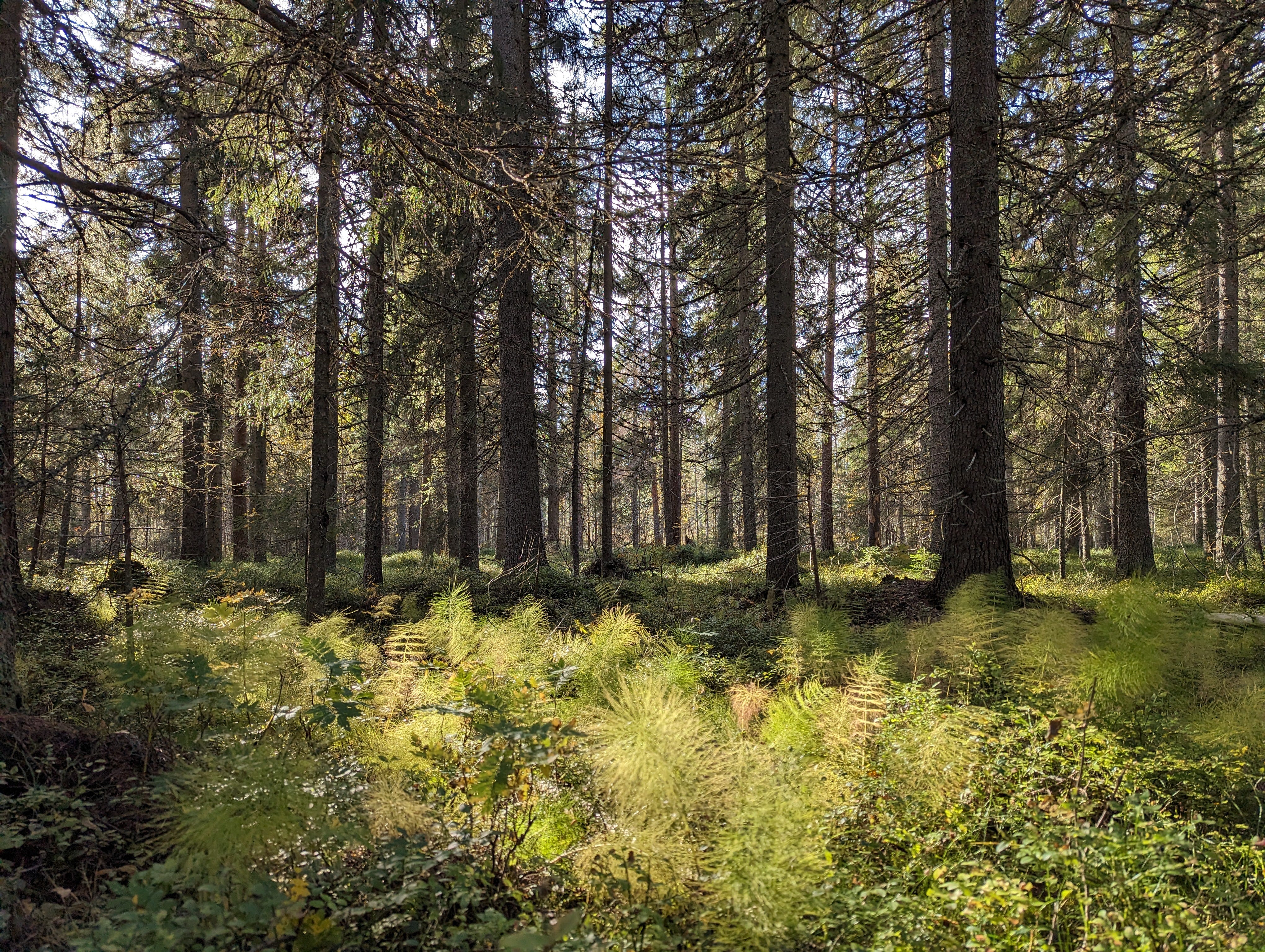
A production forest in Northern Sweden used by the timber industry, September 2023.
But how can this be? Unfortunately, forests are not a failsafe carbon capture solution, and as it turns out - quality matters. The timber industry has contributed to a surge in tree monocultures that are easily stressed by drought and infestations. However, when healthy, forests can resist droughts and are effective habitats for a wide variety of species, an essential component to the overall resilience of the global ecosystem.
There is more. Inside each tree trunk are vast numbers of microorganisms making up a microbiome, very much like in our gut, the New Scientist reports. The soil beneath our trees contains an important network of fungi. Their symbiotic relationship is something we are only beginning to understand. This is the subject of one of my favourite nature books of all time, Suzanne Simard’s Finding the Mother Tree. In this memoir, the Canadian scientist details how she challenged the establishment by researching how fungi connect with trees to create mutually beneficial systems.
In recent years, we have gained a more fluid understanding of how holistic value is tied to our natural systems, not just forests, but across all habitats. Indeed, our narrow focus on greenhouse gases and climate change must shift to planetary resilience as a whole. Emissions are an important part of the story, but they are only one piece of the puzzle. Though this does not make the task of saving the planet any easier.
Recently, a private equity executive shared with me his dream to acquire degraded land in Europe and reforest it. I am a huge fan of people taking things into their own hands and seeking to make a positive impact. Anyone doing this, regardless of the dimension, deep pockets or not, should be supported. In this case, much of the property offered to him was a mix of degraded land and forests. He expressed disappointment to me that here, in the forested parts of the land, he would not be able to make any considerable impact, as he perceived forests to be positive climate contributors. He did not realise that there are healthy forests and damaged forests, which have lost their ability to support the planet. Given the location of the land, it was not likely that this specific forest was healthy. Indeed, forests can be massively upgraded with diverse growths, by leaving deadwood, reducing logging pressure, improving soil quality and creating improved habitats for insects and other wildlife. In the UK, there is currently an initiative to reforest vast tracts of land, which also includes soil quality and fungus growth upgrades.
The point which the executive missed is that forest quality matters. Maybe he should have spent more time bathing in the forest. Shinrin-yoku, the Japanese forest bathing movement, is about experiencing the forest as a whole: Its sounds, scents, light, and air together. And when you truly immerse yourself, you begin to feel the health of the forest itself. In Japan, millions of government dollars have been poured into scientific research to better understand the effects of nature therapy, mostly via stress reduction and the implications of this on immunity, the nervous system and cardiovascular health.
The geography of Japan plays a role. In fact, 93% of its population lives on just 33% of the land, which is scrunched up and crammed into sprawling megacity corridors. Forests and mountains blanket the rest. Remarkably, among industrialised nations, it is only Finland that has a higher forest density than Japan. The government encourages forest bathing to improve the overall well-being of its citizens, many of whom are seniors.
I love Walking in the Woods, Yoshifumi Miyazaki’s book on forest bathing, because of the respectful reverence it attributes to forests. For those who can’t easily meander in a forest, Miyazaki advises that even just looking at a Bonsai tree or touching a piece of wood can have a calming effect and lower stress. He even advocates the act of soba noodle making in the forest. Miyazaki reinforces all of his nature tips with scientific research that has delved into the stress reduction effects of forests. It’s honestly what makes this book so wonderful and a little quirky.
While Japan was the first nation to get the ball rolling, there are other nations starting to follow suit by handing out “nature prescription programs” today. These are formal schemes where doctors, nurses, or social care professionals prescribe time in nature for patients, just as they might prescribe medication. PaRx in Canada is the most developed state program; over 5,000 healthcare professionals now use it, and the Canadian Medical Association has officially endorsed it.
The link between a person’s healthspan and planetary health should not come as a surprise. We are part of nature, too. Don’t get me wrong. The forest’s role in slashing emissions is essential and should be supported with investments via voluntary carbon markets and other means. Yet, I also think we need to adopt a more holistic view of forests. Our perspective needs to include biodiversity and resilience, because we don’t just need forests, we need healthy forests.
Some investors are recognising just this. There are numerous VC funds focused on climate change. Now there are specialised funds with a mission to improve biodiversity. In January 2026, Superorganism, a San Francisco and New York-based fund founded by Tom Quigley and Kevin Webb dedicated exclusively to biodiversity, completed its fundraising. Another notable initiative is the Switzerland-based venture builder Brainforest, which focuses its interests on forests, fungi and the soil microbiome.
Superorganism has already invested in several startups whose mission is to increase the quality, not just the quantity, of our forests. They invested in Foray Bioscience, an MIT startup pioneering seed fabrication to ensure more biodiverse forests. Another startup, Funga, restores the forest soil microbiome to create healthier ecosystems, faster tree growth and additional carbon capture.
Returning to the private equity executive with his forest dilemma. I connected him to a very knowledgeable forest ranger. As far as I know, they already have a concrete piece of land in consideration, with a sizeable amount of forest. I am sure there is a lot that can be done to upgrade the health of that particular forest and their plans include this now, too.