
Every morning, I simultaneously marvel and curse at the fact that our dog wakes up at 6am sharp. Unlike humans, he does not track time, he just listens to his body. At first, I thought he was aware of dawn, but the inner dog clock works regardless of the season.
We humans have seemingly lost that ability. Almost all of us are tracking ourselves electronically to guide ourselves to live healthier lives. This comes with clear benefits for our longevity.
Indeed, we try to get our steps in and most of us drink far less than we used to because we are more attuned to see how even a single glass of wine can disrupt our sleep. Tracking even removes the need for medication for some people altogether. Take Type 2 diabetes, with strict glucose monitoring and healthy lifestyle changes, some people have been able to reduce or come off their meds entirely.
One of the recurring themes of my posts is how we can live the good life by adopting habits that literally last a lifetime. Tracking can help us form lifetime good habits. For example, a Polar tracker has been part of my runs for at least two decades and now I track a whole lot more.
But for some people, tracking also causes stress. There are numerous studies showing the adverse effects on mental health that tracking can have, as highlighted by National Geographic.
“Orthosomnia” is a form of insomnia caused by sleep tracking. Users can develop anxiety, guilt or obsession over unmet goals from fitness trackers. These people develop numbers-driven health expectations and stop listening to their own bodies altogether.
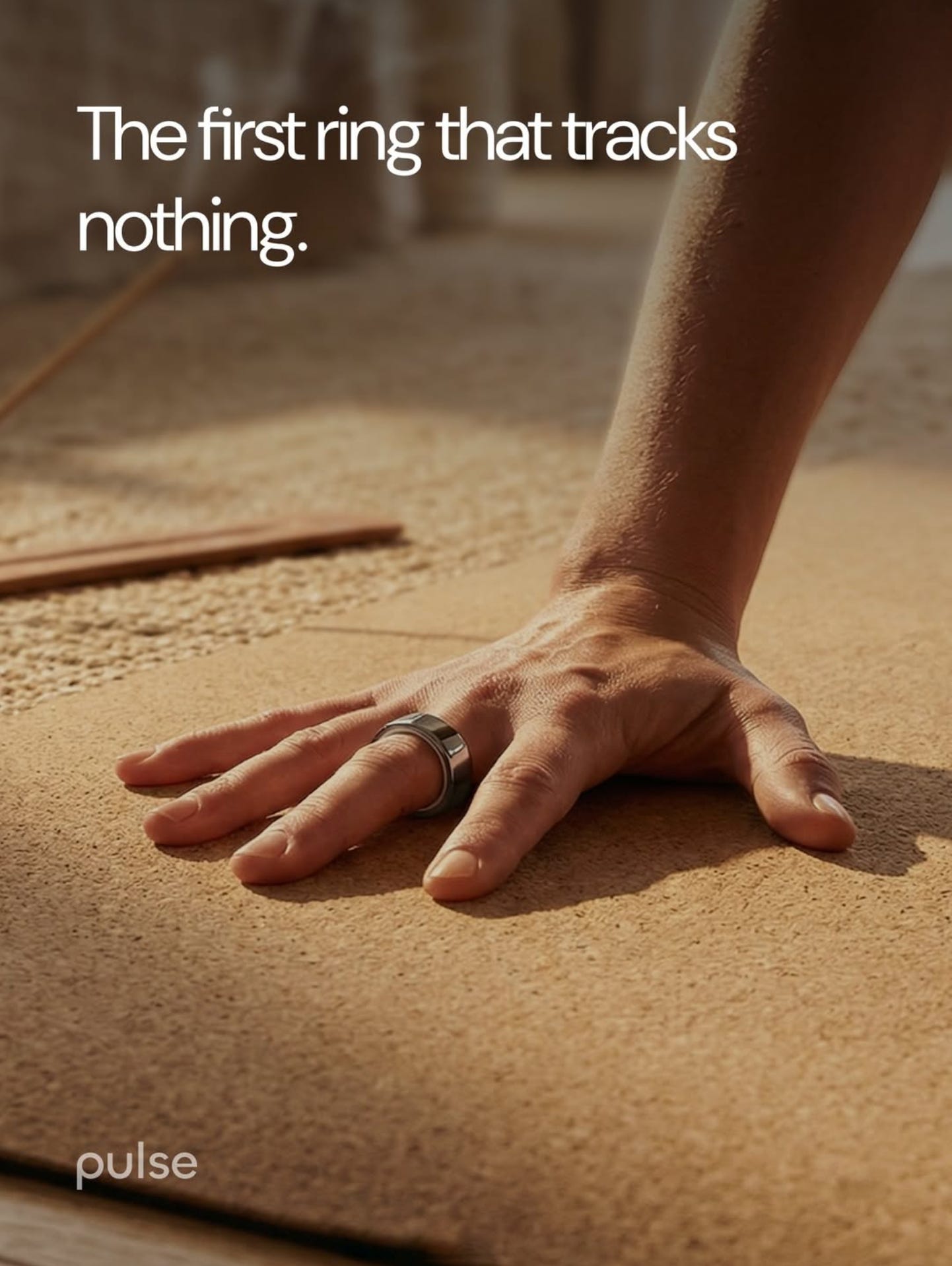
This poses the question as to whether technology can effectively help with the awareness of our body without prompting stress from continuous tracking, information and data. This was Swedish founder Johan Matton’s vision when he created the Pulse Ring, a mindful ring that purposely tracks nothing. Sounds odd, right?
What the ring does is as simple as it is genius. The ring subtly vibrates to gently bring the wearer out of autopilot and ‘stay present’. This can be anything. A reminder to breathe deeply, a hint to get up from one’s desk or a prompt to think about the beauty in life.

The Pulse Ring, image used with permission by Pulse Mindfulness Inc.
I spoke to Matton about his ring, which registered over 14,500 advance orders before its release.
“Some people need some external pressure, but real change doesn’t actually come from information, it comes from experience,” he said.
“We have plenty of tools that measure us, but very few that remind us to actually feel. We can monitor our sleep, but can we truly rest? We can track our heart rate, but can we slow it down? That is why we built something different. Not more data. Not more dashboards. But a shift toward well-being that you can actually feel. The Pulse Ring doesn’t track you, instead, its main job is to bring you back to the present moment without asking for your attention first”.
The ring is the kind of device Steve Jobs would have approved of, simple and minimal. The investors backing Pulse Mindfulness Inc., the startup behind the ring, have definitely made the right move. They are led by The Inner Foundation, a specialised fund for inclusiveness and mental health associated with Northzone. Additional backers include a handful of Swedish angel investors and Heartfelt, a first ticket fund from Berlin. In fact, it’s Heartfelt which kindly introduced me to Matton.
Moreover, I’m convinced the Pulse Ring is just the beginning. The device allows us to glimpse into the future. Pushing even more data and performance into apps is likely a dead end. We are already overtracked. Some of us are hooked, and for many, this is stressful - even if we don’t realise it. Yet there is no doubt that technology can help guide us because, unlike my dog, we are no longer in tune with our bodies. Innovation will happen not only regarding better metrics, measurement and biomarkers, but also in how tech interfaces with the human body - and I am convinced there are many more undiscovered and less intrusive paths.
Experimentation time. While working on this post, I decided to test to what extent I am compulsively hooked to my tracking.
I decided to stop tracking my steps, fitness, weight and calories for one week. What a disaster that was! It started with the rowing machine on day one. I had a strong urge to secretly turn the tracker back on, just for the rowing exercise, so that I would capture the effort I put in. When I realised this would mean breaking my plan to stop tracking for a week, I then turned my thinking around. My impulse then shifted to ‘maybe I don’t have to row then’. My logic was, if the tracker won’t capture my rowing, then I don’t really have to do it. Regardless, I pushed past that and ended up rowing without my tracker. This did not feel great. Quite the opposite, it felt like wasted work. I went to sleep that evening, still without my tracker, and woke up without any sleep data. That was the end of the test.
One week of no tracking turned into a singular day and night of no tracking. This failed test was quite enlightening for me and I recommend you try the same.
Now I know that I am truly tracking-obsessed. It’s a strange realisation, but tracking still keeps me on the honest path regarding exercise, sleep, nutrition and cardiovascular health.
The challenge for entrepreneurs and scientists is obvious. We do not only need technology to adapt more to our bodies, but we also need the technology to be more subtle and less addictive - in order to make the real benefits happen.
In the long term, Matton’s Pulse Ring is just the start – let it inspire us.